
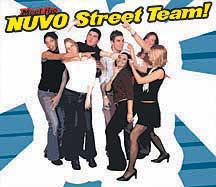
Sometimes word of mouth is a more effective way of promoting a paper than a print ad. That's why some alternative newsweeklies send street teams out to bars, movie theaters and cultural events to hand out freebies and stir up interest in their papers. When they dispatch their street teams to public places, alt-weeklies like NUVO and Boston's Weekly Dig are relying on a centuries-old marketing technique the music industry revived.

In an interview with A.J. Daulerio of The Black Table, New York Press editor-in-chief Jeff Koyen doesn't disappoint those who expect from him "a certain level of infamy," as Daulerio puts it. Koyen claims the alt-weekly model "is dead or dying," and the aging, liberal editors of those "stale, homogenous products" have lost touch with the young. He admits the Press, too, was aging badly, but he's trying to convert it back into "a venue for emerging talent." The result is more and younger readers, he says.
Metroland writer Travis Durfee spent the past month taking bucket baths, sleeping on mats and eating lamb kabob as he traveled throughout the Central Asian nation of Afghanistan. In the small city of Kunduz, he observed the crush of patients hoping for an appointment with an eye-doctor's assistant during a two-week camp run by the National Organization for Ophthalmic Rehabilitation. An estimated 2 percent of the country's population is blind, many of them from treatable conditions.
Jeff Koyen, editor-in-chief of New York Press, introduces the weekly's new design and structure by way of reminiscing about his first nine years with the paper and the lessons he learned on his journey up the masthead. NYP's new look, which hit the stands March 31, was developed and shepherded by creative director Nick Bilton.
Orlando Weekly writer Deb Berry never had much use for feminism, until she joined the March for Women's Lives in Washington, D.C., and fell in with a group of people who are mad as hell and aren't going to take it anymore. She had to leave her protest sign, "John Ashcroft Is a Sexually Repressed Woman-Hater," behind in a broken-down bus and rely on her voice to respond to anti-abortion protesters who lined the route.
Because state law keeps secret most accusations made to the New Mexico state dental board, the public has little opportunity to find out if their dentist has been the subject of complaints, Brendan L. Smith writes in the Santa Fe Reporter. The paper's examination of some publicly available records uncovers cases in which the board approved licenses for dentists who had been convicted in other states of molestation and drug abuse. The patients of one Santa Fe dentist accuse her doing unnecessary and substandard full-mouth reconstructions.
Because of the advent of DNA forensics, thousands of convictions in the United States have been overturned in light of new physical evidence. According to recent studies, 80 percent of these wrongful convictions were based upon false or mistaken eyewitness testimony. David S. Bernstein of the The Boston Phoenix reports on the outmoded techniques the Boston Police Department uses for eyewitness identification. He describes three convictions that merit another look.
"The source seeking anonymity isn’t 'bucking the system' -- he is the system," David Ehrenstein writes in L.A. Weekly. It's not just the Jayson Blairs of the news industry who deceive readers; it's those reporters who publish dubious information supplied by public relations representatives whose identity and motives remain concealed. In some journalistic circles, shoe-leather reporting has been replaced by a formula Ehrenstein describes this way: "Promise the bosses at your paper that you will get scoops, then cut deals with highly placed individuals to serve as their conduit to the front pages."
