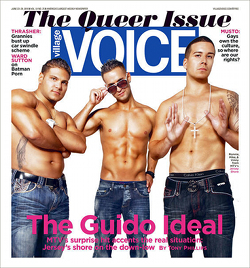

A Weekly photographer who was shooting on the public sidewalk outside a FBI building was confronted with a security guard and four federal agents when he was taking pictures for the paper's cover story this week. "It became pretty stressful -- they weren't interfering with the shoot by blocking us, but they kept asking us questions and at a certain point I said 'Well, I feel pretty intimidated, I think we're done here,'" Steven Miller says.
This week the paper debuted its drastically redesigned print publication and also rolled out changes to its website. Editor-in-chief Mara Shalhoup says the process began about nine months ago, with questions like "What if we turned the paper into the type of publication that existed only in our imaginations?" and "What was to stop us from rethinking ... everything?" The print overhaul was led by newspaper designer/art director Ron Reason, who goes into detail about the process and the thinking behind a number of decisions in a blog post.
By now, most publishers have come to terms with the basics of search engine optimization, but don't get too comfortable. Mike Volpe, from web marketing company HubSpot, will be in Toronto to explain the changes to the way in which search engines work. Volpe will give conventioneers tips on how to adapt and optimize your website in order to remain competitive in the future.
As an example, he says, SEO is becoming more time-sensitive and more personal. Google's new search index, Caffeine, just announced this week, will use more "real-time" results, which means that timely news and blog posts, as well as social media status updates, will become increasingly important to maintaining high search visibility. In addition, Volpe says search engines are beginning to use your physical location and search history more, and will eventually move into social search, which adds what your connections like and use to the mix. Many of these developments could bode well for alt-weeklies, which have strong content based around a locality and often have robust social communities. But that won't do you much good if you are falling on the second or third search pages. After Volpe's talk, you should be ready to make changes to your site that will prepare you for the future of SEO.
Current Westword web editor Joe Tone has been named the next editor of The Pitch. He will take over for C.J. Janovy, who is moving on to a communications job at the University of Kansas Medical Center. "I'm just thrilled about getting to Kansas City and getting to work," says Tone, who has also served as the managing editor at Cleveland Scene. "The city is obviously brimming with great stories, and The Pitch newsroom is well armed to tell them. Filling those ass-kicking boots of C.J.'s is going to be no small feat, but I'm looking forward to trying."
On MSNBC's Countdown with Keith Olbernmann Monday night, the host named South Carolina Sen. Jake Knott June 7's "Worst Person in the World," mostly based on a Columbia Free Times piece on how Knott had called an Indian-American gubernatorial candidate "a raghead that's ashamed of her religion trying to hide it behind being Methodist for political reasons."
AIDS Walk Boston, which took place last weekend, turned 25 this year, and to mark the milestone, walk organizer AIDS Action honored 25 individuals whose contributions to the fight against AIDS have been invaluable. Phoenix publisher Bradley Mindich was one of them. He was lauded for his decision to distribute safer sex kit in every issue of the paper in 1987, as well as the Phoenix's long association with the AIDS Walk. After distributing the kit, Mindich was called a "murderer" in the pages of the Boston Herald and Boston Archdiocese newspaper The Pilot for making birth control freely available, according to AIDS Action.
When you have a president who not only admits he inhaled but confesses to having used cocaine, it’s time to redefine "alternative," according to Henry Scott. At the Toronto Convention, the newly named publisher of Creative Loafing (Atlanta) and chief marketing officer of all six Creative Loafing papers will discuss what the company is doing to redefine the traditional "alt-weekly" and make it meaningful to an audience that would rather be well employed and raise a family than drop out of society and rebel.
Scott -- a self-professed member of the Woodstock Generation -- says he had long ago quit reading alt-weeklies because he found them irrelevant. He says market research he did at previous jobs at the New York Times and Metro New York showed him that most young people agreed. So he and his Creative Loafing team have rethought their approach, using easily available market research and staff coaching. In Toronto, he'll talk about how they are doing and he'll detail both the research and business aspects of the strategy.
Creative Loafing (Sarasota) food writer and restaurant critic Brian Ries is taking over the top editor position at the paper, replacing Cooper Levey-Baker, who has left to edit the Florida Independent website. Ries says he will continue his food writing, which leads to an interesting conundrum: he will try to maintain his anonymity while performing a much more public role as the paper's editor. "Soon, there will be plenty of pictures online that restaurants could use to identify me, if they want to go to the bother," he writes. "In my experience, restaurants don't perform well when they know a critic is in the dining room, perhaps because the pressure gets to them. And I won't make it easy for them -- I'll continue to make reservations under another name, use an alias credit card, and shave my legs to match the summer dresses I plan on wearing as a disguise."
"SF Weekly has always been your essential guide for where to go, where to eat, and what to do," the paper says, "and now we have, well, an app for that." The free app features easily searchable event and restaurant listings as well as editorial coverage of nightlife happenings and slideshows.
New York City is facing a new class action lawsuit over the NYPD's use of quotas to get officers to issues summonses and stop-and-frisk people, and the suit reportedly cites some of the quotations which appeared in the Village Voice's NYPD Tapes series. The series, which features secret tapes made by a former cop, shows that precinct supervisors order their officers to hit quotas for tickets and stop-and-frisks, and threaten them with disciplinary action if they don't comply.
- Go to the previous page
- 1
- …
- 236
- 237
- 238
- 239
- 240
- 241
- 242
- …
- 1,275
- Go to the next page